
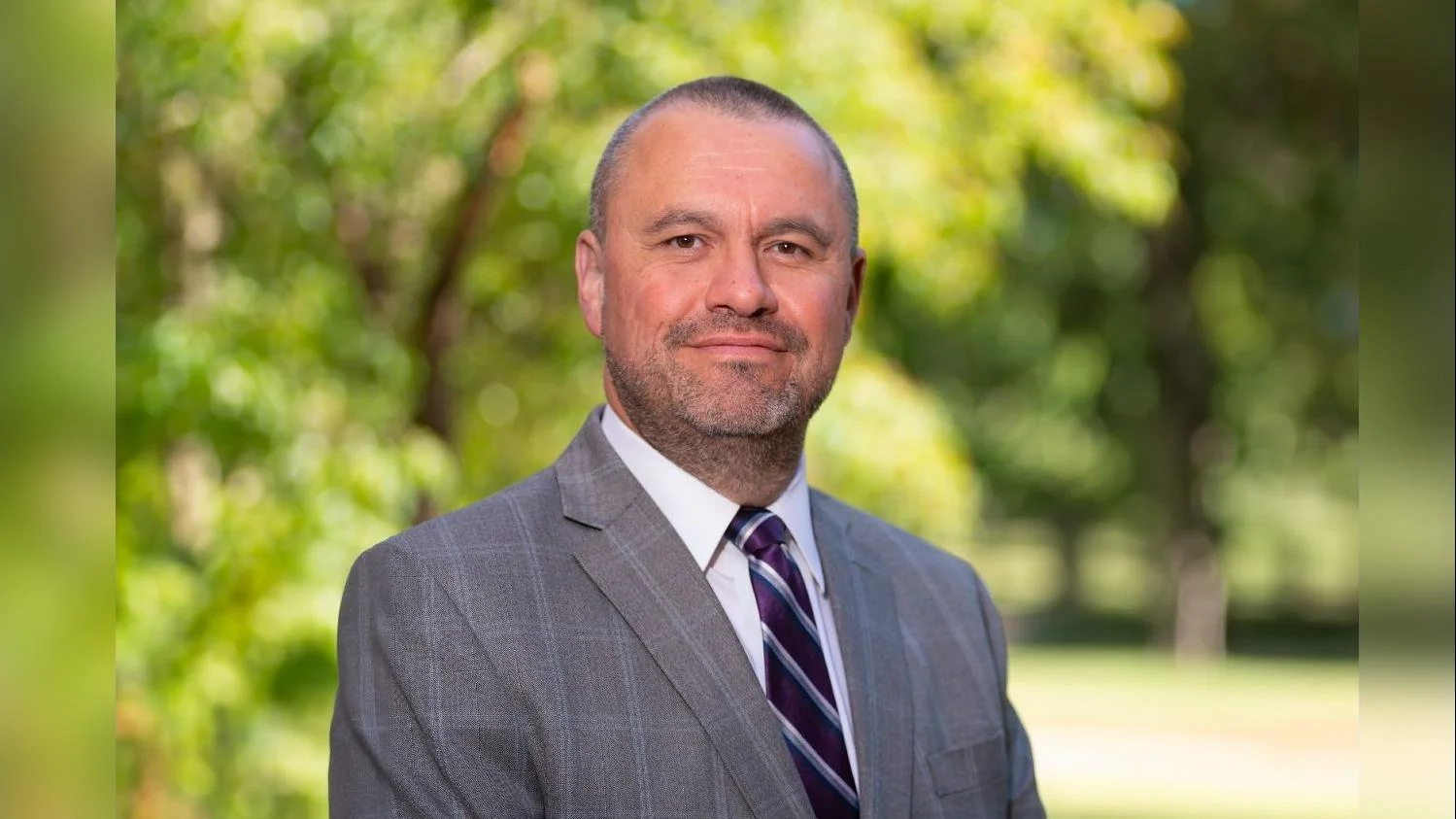
Illinois Institute of Technology researchers have developed a predictive model that was used to inform Indian government policy during the COVID-19 pandemic. The work, led by Sanjiv Kapoor, professor of computer science, and Yi Zhang (Ph.D. CS ’25), is detailed in their paper “Models for SARS-CoV-2 Health Policies: Social Distancing Amid Vaccinations and Virus Variants,” published by The Royal Society.
The model expands on traditional epidemiological models by including factors such as human behavior, different levels of lockdown policies, vaccination rates and their time-lapsed efficacy, and the emergence of new virus variants like Delta and Omicron. Kapoor explained, “We were able to use a model that we developed earlier, which incorporates human behavior into population interaction parameters, as well as changes in the susceptible population dependent on relaxed/stricter government policies. This modifies the standard SEIR model developed many years ago. We were able to apply our model to a real-world situation, impacting a large population.”
Their updated Susceptible, Exposed, Infected, Asymptomatic/Undetected Symptomatic, Recovered with Linear population changes (SEIR-SD-L) model introduces new compartments for individuals treated in hospitals or at home, those who died or are under lockdown, vaccinated members of the susceptible population, and people affected by virus variants. By adding these compartments, the researchers achieved more accurate predictions about how COVID-19 could spread.
According to data from their publication, predictions made using this model on December 1, 2021 were found to be 82 percent accurate on average when checked 15 days later.
Kapoor noted challenges with predicting public responses to policy changes: “The biggest challenge was the lack of predictability as to how the population would react to government policy changes, thus altering long-term predictions. We would like to extend this work to improve the models of behavioral aspects of the population. In the current model we have incorporated a pullback in the population’s interaction behavior when infection cases rise. Other parameters to include [down the road] should address exhaustion from restrictions and risk-taking behavior.”
From June 2021 through March 2022, this predictive tool was used monthly in India during a period when hospitals faced severe strain from COVID-19’s second wave. The results were provided to NITI Aayog—an Indian public policy think tank responsible for creating preventative measures against COVID-19.
Kapoor described his connection with policymakers: “I was connected to senior personnel at the government agency through an ex-colleague after he heard about my work on COVID modeling. It is not clear to me as to exactly how the work was used for policy decisions, as long-term predictions are not accurate but [can] serve as a warning about the severity of infection spread. To our knowledge, the predictive reports were used for policy decisions and particularly welcomed was the pre-warning on Omicron."
While exact peaks in case numbers could not be predicted precisely by their approach, Kapoor’s team provided forecasts that gave decision-makers valuable guidance during critical moments.
“We aim to apply this for modeling the spread of infectious processes especially viruses in computer networks,” Kapoor said.